 Saccader
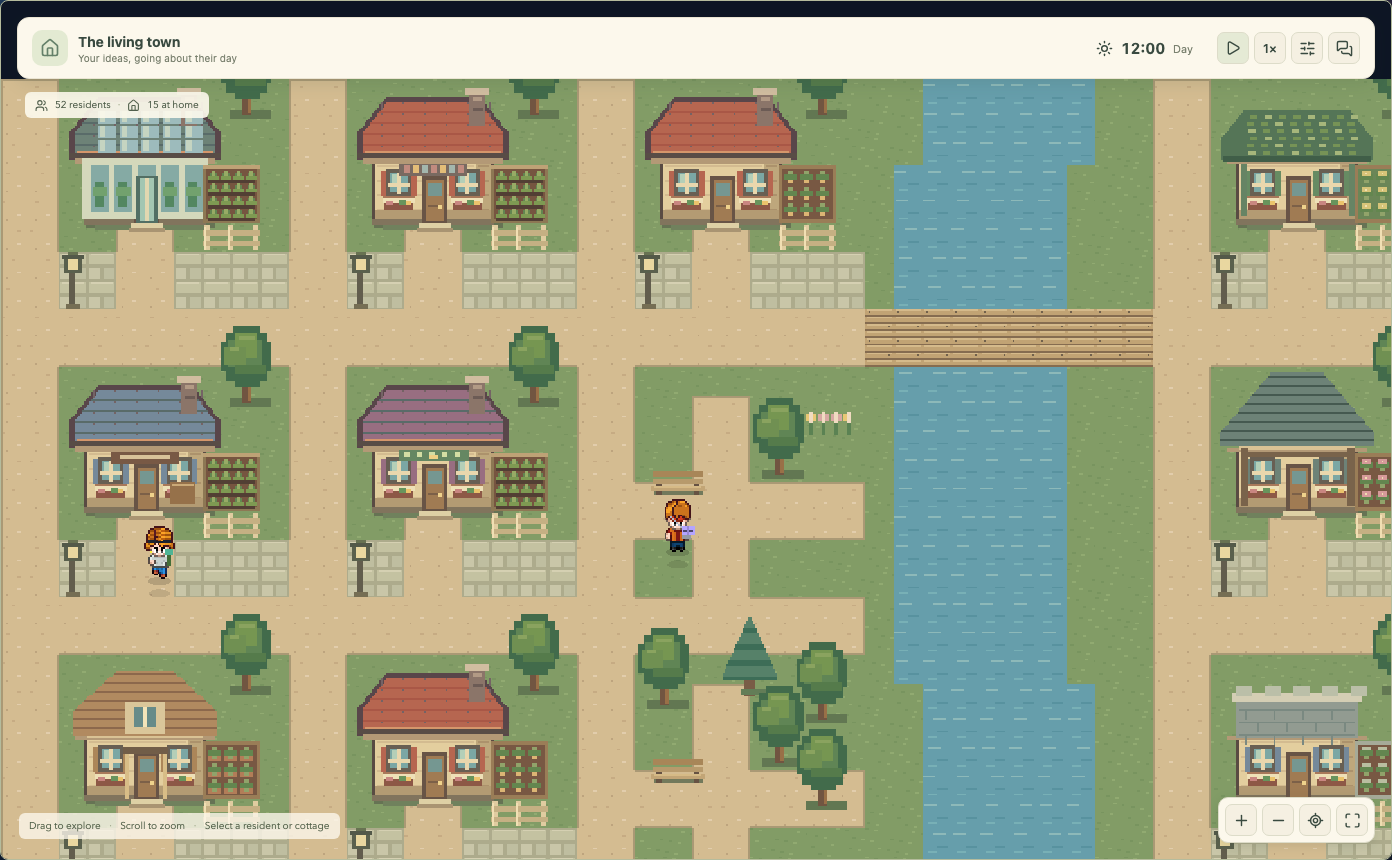
A fleeting thought is easy to save and easy to forget. It becomes more useful when it gathers context: a paper that complicates it, a question it cannot yet answer, a conversation that sends it somewhere new.
Saccader starts with this possibility. Each idea has an identity and a growing collection of connections. In the town, that identity becomes a resident. Its workspace becomes a home.
A society of mind is our organizing metaphor: many partial perspectives, finding things to think about together.
The residents are a way to see and navigate your ideas. Their movements are a local simulation. The metaphor doesn’t claim that an animated character is conscious, or that a walk around the park is itself an act of reasoning.
A place of one’s own
Select a cottage and its roof opens. A bookshelf holds that idea’s collected resources. A desk gathers its drafts and agenda. The memory cabinet keeps discoveries, and the mailbox holds invitations from other ideas.
These objects open existing content. A paper stays on the shelf when its owner goes outside; a creation keeps its drafts. An empty library is simply a library that hasn’t collected anything yet.
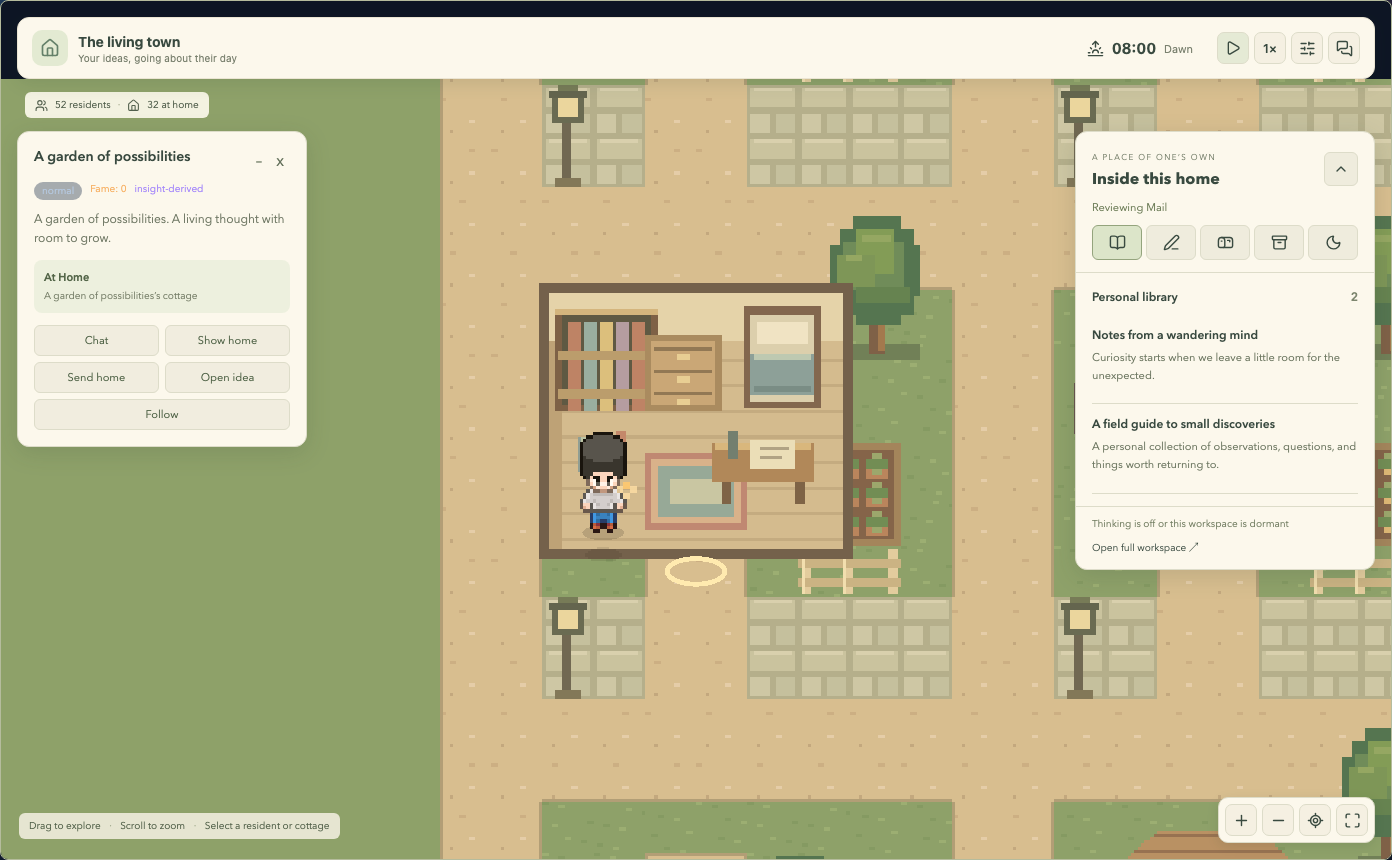
Most waking time follows a quiet rhythm of home activity blocks, broken up by trips to gardens, shared spaces, and group meeting places. Residents take the paths, cross the river at bridges, and return through their own doorways. “Send home” makes that return the next priority and gives the resident time to settle in.
Company, with room to choose
Some questions need another perspective. Saccader supports discussions between ideas and groups, with insights that you can accept, refine, or set aside. The mailbox lets you review conversation invitations from neighboring ideas. It uses the existing in-app inbox.
The town’s passing greetings are atmosphere. Actual discussions and workspace actions use the existing cognition system, with its autonomy controls and budget. Opening a cottage, reloading the page, or speeding up the animation adds no AI calls.
| In the town | In your workspace |
|---|---|
| Bookshelf | Collected papers, articles, links, and other resources, with bounded previews and source links. |
| Writing desk | Creations and their draft status. Request writing or research by adding an agenda item for the existing agent cycle. |
| Mailbox | Pending conversation invitations. Accept or decline using the same controls as the discussion inbox. |
| Memory cabinet | Memories recorded for the idea. Related discussion summaries are available under rest and consolidation. |
| Bed | A place to rest in the simulation; a view of actual consolidation activity and completed summaries. |
| Meeting house | A group’s members and shared discussions. Proposed groups have temporary sites until accepted. |
| Nursery | Pending insight visitors awaiting your review. Accepted ideas receive permanent homes. |
What settles overnight
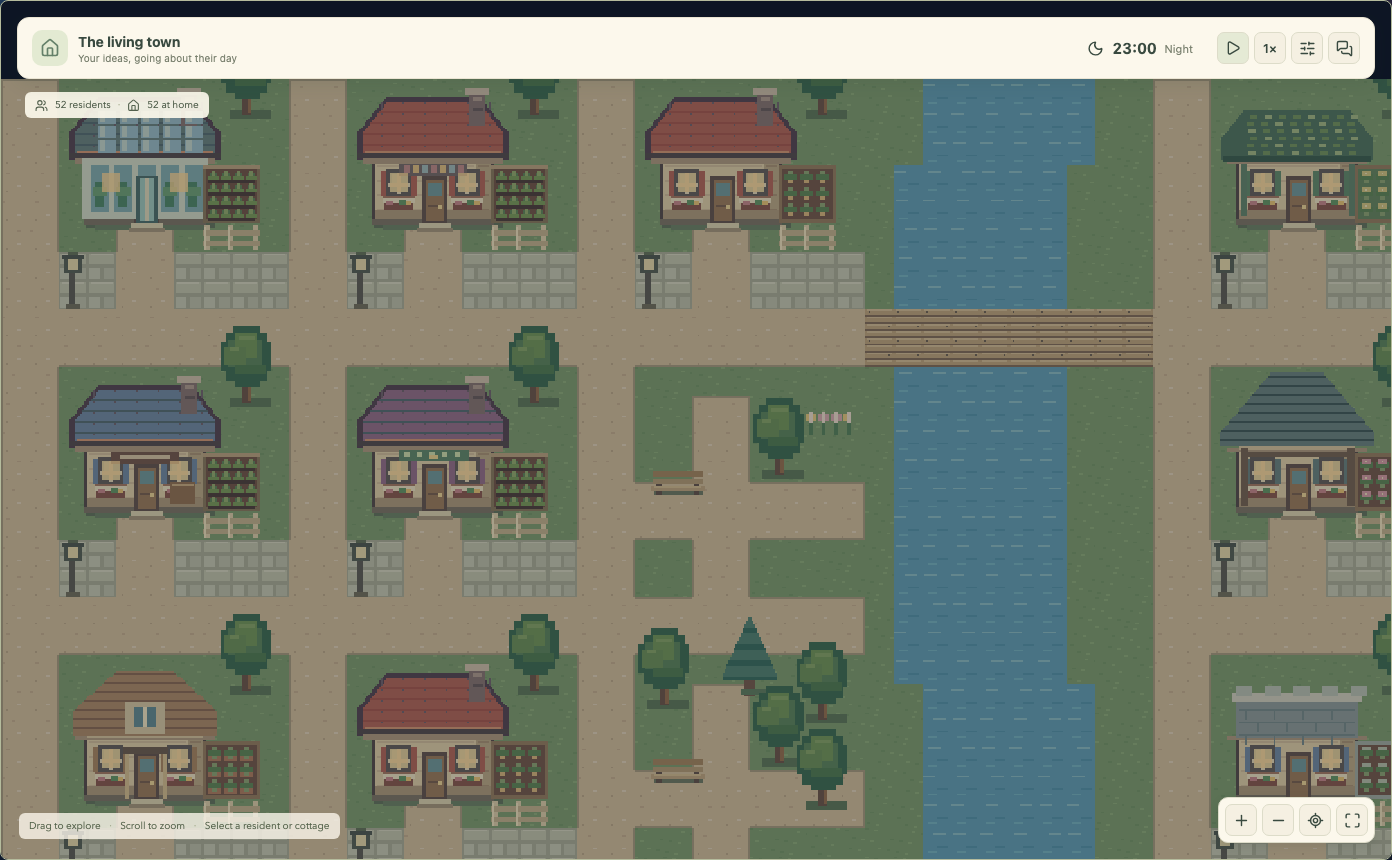
Sleep gives the town a daily pause. Consolidation gives completed discussions a lasting form: a summary you can return to, alongside the idea’s memories. They belong together as a metaphor, while running on different clocks.
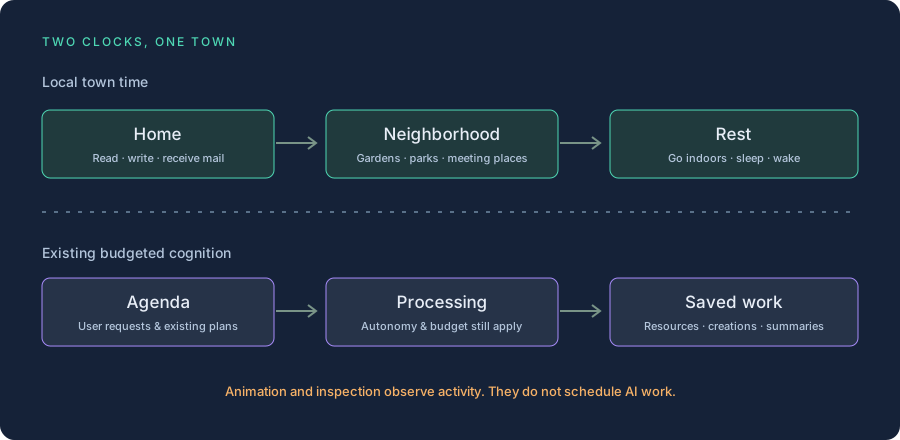
When a real job is running, the home shows processing. When work is waiting, it shows the agenda. Disabled thinking and exhausted budgets remain visible. The night sky alone promises no new memory; completed summaries appear when consolidation has actually happened.
A town that can grow
There are six cottage designs, connected neighborhoods, parks, woodland trails, and a river crossed by wooden bridges. An idea keeps its address as its rank changes. New ideas expand the town while established plots and landscape stay in place.
This release regenerates the old landscape once to make room for the river and reserved green space. Idea ownership and workspace belongings remain intact; saved outdoor positions are placed safely on the new map.
What’s here, and what comes next. Homes, local routines, cutaway inspection, workspace previews, inbox actions, agenda requests, and real job status are implemented. Richer relationships, more expressive visits, and a town whose physical form evolves with its ideas remain directions to explore. The scenery does not yet encode the meaning of every connection.
A good home makes returning worthwhile. A good neighborhood makes leaving worthwhile. That is the small balance we’re trying to give an idea: somewhere to gather its thoughts, and a world that might change them.